

March 1, 2026 | | This post is also available in: Arabic
Displacement and Suspended Property Rights
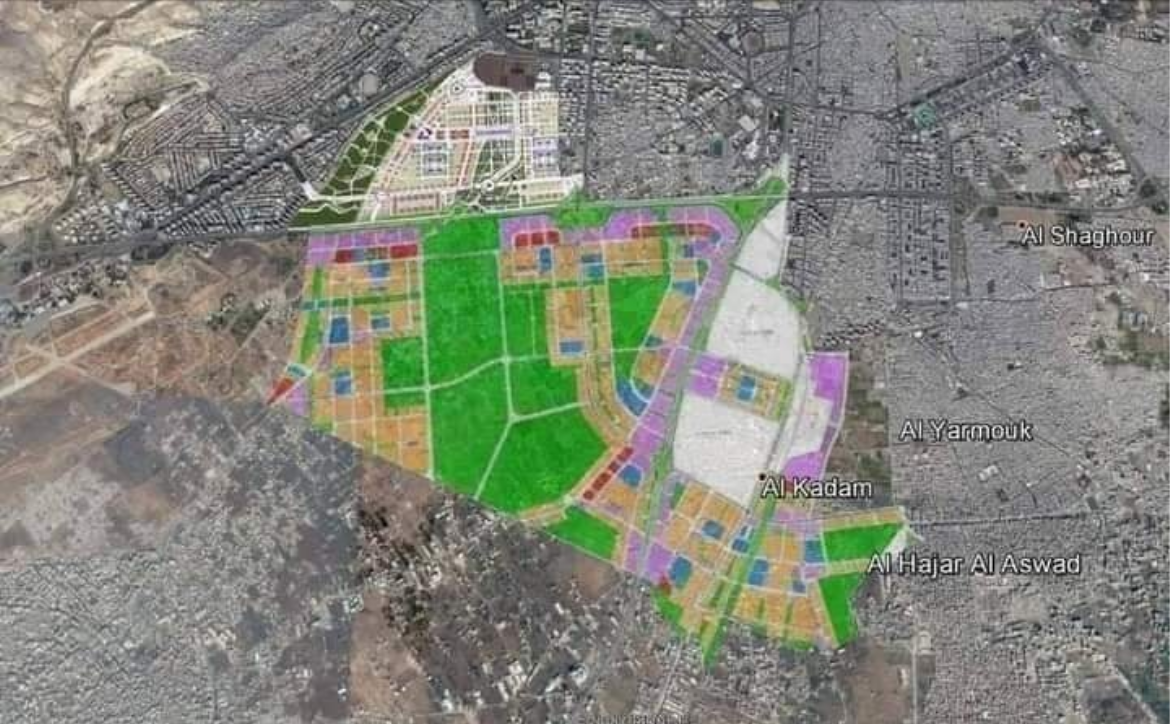
When the Marota (and Basilia) City project was announced in Damascus in 2012, it was presented as the jewel of a new capital: glass towers, luxury apartments, shopping centres, and wide boulevards promising the birth of a “modern” city. The Damascus Governorate promoted it as a flagship reconstruction project, and some portrayed it as a model that could be replicated across other Syrian cities.
But for the tens of thousands of Syrians who had lived in the Basateen al-Razi neighbourhood, where Marota’s foundations were first laid, and the larger number affected by the larger Basilia City, the project was a symbol of displacement and exclusion. Their homes were demolished, their property rights converted into opaque and unfairly priced shares, and they were promised “alternative housing” that has been long delayed.
The area covers approximately 2.2 square kilometres and is home to around 50,000 residents. At the time, the authorities promised to build 12,000 housing units to accommodate 60,000 people. Yet most of the original families were excluded from the outset. Before 2011, nearly half of Syria’s land was not formally zoned, meaning thousands of families relied on customary or inheritance documents that lost their value before opaque government valuation committees. Many received shares that did not reflect the true worth of their properties; others lost everything because they lacked official documentation or because their papers were lost during displacement.
Promises of alternative housing were not fulfilled. The law stipulates that replacement homes must be delivered within four years of eviction, but more than a decade has passed and many residents are still waiting. Some received meagre rental compensation that did not exceed 500,000 Syrian pounds annually, about $137, an amount insufficient for dignified living. This forced many to sell their shares to afford rent away from their land and neighbourhoods. These conditions were combined with loss of income for many who made a living from a shop or piece of land they owned.
The situation was worsened by the fact that refugees and the internally displaced were often unable to claim their rights at all. The laws required personal attendance or official documents that were frequently lost or impossible to obtain. For millions of Syrians abroad, or those fearing security repercussions, the path was effectively blocked from the start, especially for those who needed “security clearance” from the Assad regime’s Intelligence Services. There are also claims that some of the shareholders, who were detained by the Assad regime’s brutal machine, were forced to sign documents selling their shares in the project.
Key Timeline: Marota City & Syria’s Reconstruction
| Pre-2011 | Informal Land Ownership
Nearly half of Syria’s land was not formally zoned. Thousands of families relied on customary or inheritance documents, leaving them vulnerable to future dispossession. Displacement Risk |
| 2012 | Marota (& Basilia) City Announced
The Damascus Governorate launches the project under Decree 66, in Basateen al-Razi, an area covering ~2.2 km². Presented as a flagship ‘modern’ reconstruction project with promises of 12,000 housing units. Policy & Planning |
| 2012 onwards | Mass Displacement Begins
Thousands of residents displaced. Property rights converted into opaque shares. Many families, especially refugees and the internally displaced, were unable to claim rights due to documentation and security clearance requirements. Displacement |
| 2012–2024 | Regime-Linked Business Interests
Companies linked to Assad-regime figures gain stakes in the project. Damascus Cham Holding becomes a central vehicle. International sanctions are later imposed on these entities for their role in displacing communities. Accountability |
| 2018 | Law No. 10 Expands the Framework
The framework of Decree 66 is extended nationwide, allowing governors across Syria to rebuild opposition-affiliated neighbourhoods in partnership with the private sector, risking permanent dispossession under the guise of urban planning. Legal Framework |
| 4+ Years After Eviction | Housing Promises Unmet
Law requires replacement homes within 4 years. Over a decade later, many residents are still waiting. Rental compensation of ~$137/year leaves families unable to afford dignified living, forcing many to sell their shares. Failed Promises |
| Late 2024 | Fall of the Assad Regime
The collapse of the Assad regime opens a rare window for transitional justice. Political space emerges to revisit the legal foundations of Decree 66, Law No. 10, and the property rights abuses embedded in Marota City. Transition |
| 2025 & Beyond | Calls for Reform & Restitution
Civil society demands independent review, judicial oversight, and community participation. Transitional authorities face pressure to establish fair compensation mechanisms and distinguish between coercive profiteering and bona fide transactions. Transitional Justice |
War Economy and Law No. 10
At the same time, the project became a golden opportunity for companies linked to influential businessmen, many of whom were linked to the Assad regime. International sanctions were imposed against these businesses and the government-owned Damascus Cham Holding for their participation in displacing these communities. This unprecedented business partnership between state-owned companies and private sector actors turned reconstruction into a mechanism for entrenching the war economy, and a tool to displace dissenting communities.
More troubling still, the model did not stop in Damascus. In 2018, Law No. 10 expanded the framework of Decree 66 to cover any area in Syria. This gave governors the authority to rebuild the widely destroyed opposition affiliated neighborhoods in collaboration with the private sector, in a fashion similar to Marota’s. Temporary displacement thus risked becoming permanent dispossession under the banner of “urban planning.”
Post-Assad: Balanced Redress Instead of Injustice Normalisation
The fall of the Assad regime more than a year ago offered a rare and long-awaited opportunity to rectify the injustices embedded in Marota City. A meaningful transitional process should revisit the legal foundations of Decree 66 and Law No. 10, reassess property valuations and opaque share allocations that failed to reflect genuine ownership, and establish independent restitution and compensation mechanisms to address wrongful dispossession, with victims’ participation. It created political space to shift reconstruction away from the logic of regime consolidation and toward a framework grounded in rights, transparency, participation and accountability.
However, protests have continued around the Marota City project. Affected communities argue that while the political leadership has changed, the policies governing the project have not fundamentally shifted. Many former residents are still waiting for a fair reassessment of their property rights, clearer and more accessible compensation mechanisms, or even a realistic path to return to their lands. Civil society warns that without independent review, judicial oversight, and meaningful community participation, the injustices entrenched under the previous framework risk becoming permanent under a new administration, thus consolidating violations of housing, land, and property (HLP) rights as well as crimes of pillage and forced displacement under international law.
Any reform of the Marota City project must also take into account the rights of those who have invested, bought, or sold property in good faith since 2012. Over more than a decade, secondary markets have developed, contracts have been signed, loans secured, and assets transferred under the existing legal framework. A resolution that ignores these transactions risks creating new layers of uncertainty and injustice. The objective should not be to replace one form of dispossession with another, but to design solutions that balance restitution for original owners with legal certainty for bona fide purchasers and investors. Transitional authorities must therefore ensure that any review mechanism distinguishes between profiteering linked to coercion or conflict, and legitimate transactions conducted lawfully and transparently. Protecting acquired rights alongside restoring dispossessed ones will be essential to rebuilding trust in both the property system and the broader rule of law.
Despite all this, Marota City continues to be presented by some as a showcase of modern reconstruction. In reality, it stands as a cautionary tale. Reconstruction that uproots communities, sidelines original residents, and converts homes into paper shares is not genuine renewal, it is the reproduction of injustice in a different form. Syria’s recovery cannot be built on confiscation, exclusion, or the erasure of grievance, but must rest on restoring rights, ensuring fair compensation, enabling safe return, and guaranteeing meaningful participation for displaced communities. Urban planning must be conducted with communities, not imposed upon them. Cities may be constructed with concrete and glass, but durable peace can only be built on justice.
How We Can Help
The challenges outlined in this article, from property restitution to corporate accountability and community participation, require not only political will but also technical expertise. We provide Business and Human Rights (BHR) consultation services to support think tanks, policymakers, and officials navigating these complex issues in Syria. Our expertise is built on experience in international law and rooted in engagement with affected communities.
Get in touch: info@sldp.ngo / visit: https://sldp.ngo/en/what-we-do