

Nov 15, 2026 | | This post is also available in: Arabic
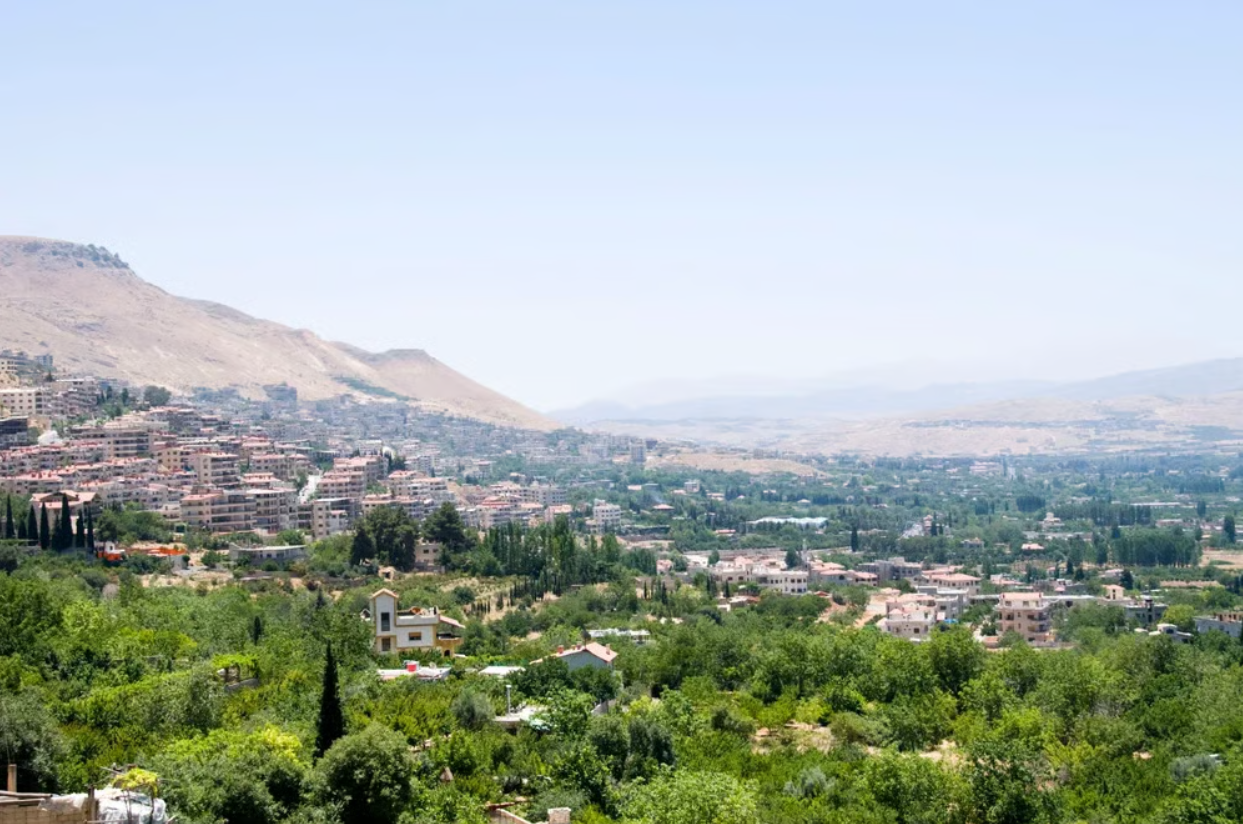
Bloudan, Syria – Safaraq, 2025.
Ahmad Saeed farms land near the village of Tarhin, in the northern Aleppo countryside. Beyond his fields stand the makeshift oil burners that refine crude into the low-grade diesel the region depends on. He described the gas coming off them to Syria Direct as a disaster, and asked how plants could survive smoke that kills men. In nearby al-Bab, a paediatrician reported higher hospitalisation rates in communities around the burners: asthma attacks and bronchiolitis in children, and skin conditions that resist ordinary treatment. His land is at once his livelihood and the source of his family’s exposure.
The scale is not marginal. PAX counted 5,791 makeshift refineries across five surveyed sites near Deir ez-Zor by 2016, with thousands of civilians, among them a significant number of children, exposed to the resulting health risks. In western Syria, more than 36 per cent of forested areas were affected by unregulated logging and intense fires between 2018 and 2020. The drought in 2024 and 2025, which FAO called the worst in 60 years, left a wheat deficit of 2.5 to 2.7 million tonnes and put some 16.3 million people at risk of food insecurity. The 2026 harvest rebounded, but FAO still counted 14.5 million people in high acute food insecurity in June 2026.
Each figure describes a human rights infringement as much as an environmental one. Contaminated groundwater impacts the right to water; burner emissions the right to health; failed harvests the rights to food, to an adequate standard of living, and, once families move, to housing. All of it engages the right to a clean, healthy, and sustainable environment, recognised by the Human Rights Council in 2021 and affirmed by the General Assembly in 2022. We have argued elsewhere that acceding to the Aarhus Convention would give Syrians the procedural means to defend these rights. But accession governs how decisions are taken from now on; it does not address what has already been done, or to whom. That is the work of transitional justice, and it is currently sidelined.
Much of the harm was organised rather than incidental. Business actors played a key role in driving environmental harm and degradation in these areas, placing profit above the interest of the Syrian people. Our research highlights the coastal charcoal trade controlled by individuals directly connected to the Assad family, with tenders to clear burnt sites awarded to businesspeople close to the regime. In the north, logging ran through the economic offices of non-state armed groups, which sold protection to timber traders. Conduct of this kind can amount to an international crime in its own right, such as pillage and destruction of property, and raises the question of ecocide.
While Decree No. 20 of May 2025, which established the National Commission for Transitional Justice, is ostensibly silent on environmental harm, such harm arguably falls under “grave violations”, the truth about which the Commission is mandated to uncover. The decree also confines the mandate of the Commission to violations by the former regime–a serious limitation, as much of the forest loss was driven by actors the Commission cannot examine at all.
Under international law, the state is the primary duty bearer. It must regulate extraction and logging, remediate contaminated sites, and provide accessible remedies. It must also rebuild an assessment function that collapsed long before the institutions did: Syria has had environmental legislation since Law No. 12 of 2012, but enforcement was hollowed out by neglect and corruption.
The Framework Principles on Human Rights and the Environment, presented by former UN Special Rapporteur on human rights and the environment, John H. Knox, provide that states should require prior assessment of the environmental impacts of proposed projects and policies, including their effects on the enjoyment of rights. Done properly, such an assessment should provide meaningful opportunities for the public to participate, consider alternatives, and account for cumulative effects.
Importantly, businesses carry an independent responsibility that does not wait for the state to act. This involves identifying and assessing actual and potential impacts of business activity, engaging meaningfully with affected groups, and integrating the findings into decisions rather than filing them. In a conflict-affected or high-risk area, it is more demanding still. The UNDP guidance stresses that such activity is never neutral in conflict-affected settings, and asks companies to assess their impact on the conflict. In Syrian reconstruction, environmental impact assessment is a due diligence obligation, not a permitting formality. Where the domestic framework is weak or unenforced, compliance is no shield.
Syrians are not waiting to be asked. In Abu Rummaneh, residents discovered that part of Al-Jahiz Park, one of the capital’s last public green spaces, had been handed to a private investor. Sit-ins, petitions, and online pressure led the governorate to cancel the deal within 48 hours and commit to a community-led alternative. In Homs, residents of al-Qarabis opposed the Boulevard al-Nasr scheme on orchard land expropriated decades earlier by the deposed Assad regime; in August 2025 the developer cancelled that component outright, though the wider boulevard proceeded and launched in 2026. The outcomes were partial, but the lesson is not: public participation changes what gets built.
Syria’s recovery pertains not only to political or economic rebuilding, but to the recovery of the land and the people who depend on it for life. Neglecting the environment risks fuelling inequalities, driving violence, and entrapping Syria in a cycle of conflict and underdevelopment. Environmental governance is therefore not a peripheral issue to be addressed once more urgent matters are settled. It is central to economic and social recovery, to alleviating suffering, and to tackling inequality and injustice. The transitional period is a narrow window in which environmental justice can be embedded into transitional justice, governance, peacebuilding, and sustainable recovery, rather than appended later when it will be far too late.
Written by: Alreem Kamal, Legal Officer, Human Rights & Business Unit