

Nov 1, 2026 | | This post is also available in: Arabic
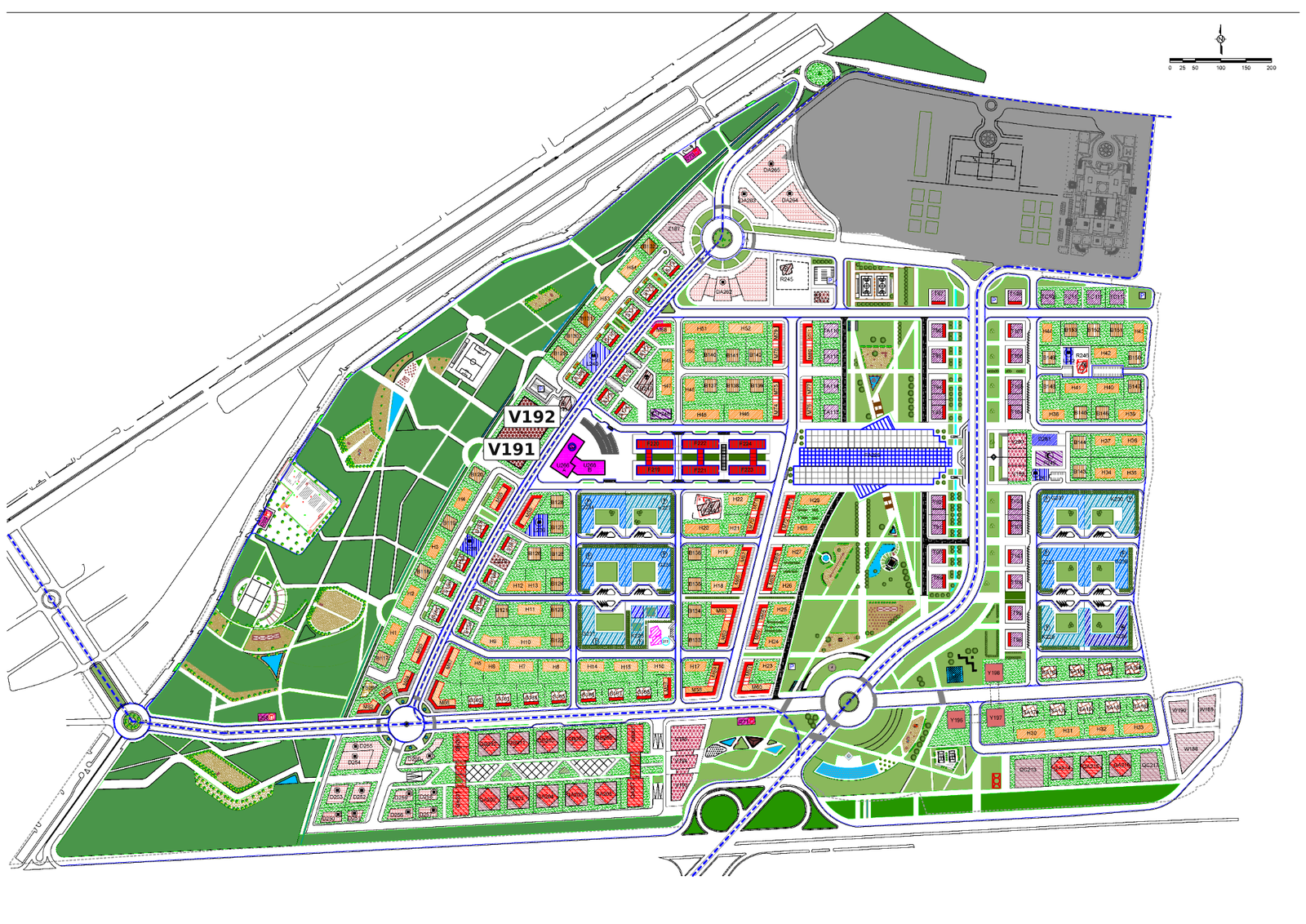
Map of plots in Marota City (a preliminary version that has since been revised).
The Marota City project was established in the orchard areas of Mezzeh and Kafr Sousa, behind Al-Razi, within the first development zone created under Legislative Decree No. 66 of 2012. Redevelopment converted rights holders’ property interests into undivided shares in plots within the development zone, intended eventually to confer ownership of specific properties. Yet the demolition of homes, delays in providing alternative housing and difficulties in deriving benefit from those shares left families facing years of paying rent and waiting, pushing some to sell their rights under financial pressure. As efforts were made to address the situation of those whose shares remained unallocated for security-related or legal reasons, Plot V192 came into focus following a decision to open a land registry record in which their rights could be registered. This process raises questions about the terms governing investment in the plot and the safeguards needed to prevent rights holders from losing their rights once again.
These safeguards are particularly important given the circumstances of the groups most adversely affected by the decree, including people on low incomes and residents without formal ownership documents. The harm was compounded for detainees, victims of enforced disappearance, people facing prosecution before the Counter-Terrorism Court and their families, as well as displaced persons and refugees unable to pursue the required procedures. For these groups, the loss of a home came alongside the loss of documents or a breadwinner, the risks of approaching official authorities, and attachment orders that restricted their ability to dispose of assets. Households headed by women, heirs and minors faced additional barriers to establishing rights and securing representation for rights holders. An inability to pursue allocation procedures in these circumstances must not be treated as a voluntary relinquishment of ownership.
The decree’s structure helps explain how this deprivation persisted. Article 36 transfers mortgages, attachments and annotations recorded against the original property to the shares and rights that replace it. Article 30, as amended, requires the absence of annotations that prevent the contribution of shares or the granting of a building permit. Article 32, meanwhile, provides for auction sales where applications for plot allocation or participation in a company have been rejected, or where owners have not chosen any of the available options. An attachment order or involuntary absence can thus become an obstacle to allocation and, in turn, a route to sale.
It was against this background that the issue of Plot V192 emerged. Community publications on the project link the plot to shares left unallocated because of attachment orders or an inability to submit applications, and describe its unallocated status as a consequence of this process. Establishing who first proposed the initiative, and when, however, requires access to the Governorate’s minutes and decisions. These accounts alone do not establish that the plot was originally created to compensate detainees’ families.
The documented turning point came on 5 May 2026, when the Damascus Governorate announced the cancellation of the scheduled auction of the plot and decided to open a land registry record for owners who had been unable to secure allocations for security-related or legal reasons. The announced measure seeks to enable holders of pre-existing rights to register them, making proof of original ownership and the shares derived from it the basis of entitlement. The official wording does not limit eligibility to the families of detainees or of people facing prosecution before the Counter-Terrorism Court.
However, the announcement that a land registry record would be opened does not establish that all eligible rights holders have completed registration, nor does it provide a detailed list of their names and shares. A distinction must be drawn between recognising shares, allocating them within the plot, registering them in the land registry, and subsequently investing in or building on the property. Each stage has its own procedures. Moving towards an agreement with an investor is not, in itself, proof that ownership issues have been resolved.
The legal difficulties begin with the status of attachment and confiscation measures. Attachment restricts an owner’s ability to dispose of property, whereas confiscation may have transferred ownership to the state. Different procedures are required to recover rights in each case. Questions of inheritance and representation also arise: the rights of victims of enforced disappearance require legal representation that protects them, heirs must establish that rights have passed to them, and minors’ shares require specific safeguards. Each case must therefore be verified, and shares issued under the redevelopment scheme checked against the original rights, to prevent eligible rights holders from being excluded or their shares reduced.
A review of the draft joint development agreement reveals additional risks that need to be addressed before signing. Signing would grant the follow-up committee broad powers of representation, including powers to settle disputes and waive claims that extend beyond managing construction work. The draft also makes all of the owners’ shares security for the investor’s rights, without any apparent corresponding performance guarantee to protect the owners if the investor fails to perform. Despite the restrictions on mortgaging and disposal, the scope of this security and the identity of the party in whose name the investor’s rights would be registered still require clarification.
The agreement makes implementation conditional on pooling a majority of the shares and securing the relevant powers of attorney. It also envisages purchasing the shares of owners who do not join the agreement or initiating partition proceedings to end co-ownership, which may result in a sale. Owners of small shares, displaced persons, refugees and rights holders unable to appear in person must therefore be protected from pressure to sign, and the implications of these procedures must be explained to them. Construction and handover deadlines, together with compensation for delay, must also be clearly defined so that owners are not left waiting indefinitely.
A fair resolution requires a publicly accessible, reasoned decision setting out the basis for allocating V192, the eligibility criteria and the method for calculating shares. Every rights holder must be able to access their case file and challenge decisions before an independent body. The lifting of restrictions must be coordinated among judicial, financial and land registration authorities. Free legal assistance and measures to facilitate procedures for displaced persons must be provided, and disputed rights protected pending resolution. Families should not bear the consequences of delays caused by restrictions arising from detention or prosecution that they cannot lift on their own.
As regards investment, signing must be preceded by an independent assessment of the value of the land and building rights, construction costs and expected returns, to determine whether the proposed participation ratio is fair. The percentage alone does not establish whether the arrangement is fair or unfairly disadvantages one party. The investor’s identity, financing capacity and interests in acquiring additional shares must be disclosed, and a single, consistent version of the agreement and its annexes adopted. Owners must freely choose their representatives, whose powers and accountability must be clearly defined, and give explicit consent to decisions affecting the substance of their rights.
Practical safeguards include a binding construction and handover schedule, final specifications, a guarantee that can be called upon in the event of breach, independent engineering and financial oversight, and transfers of rights to the investor tied to actual progress on the project. Provision must also be made for recoverable compensation for delay, the right to terminate the agreement if the project stalls, sufficient time to review and challenge the valuation, and a fair dispute resolution mechanism. Recognition or registration of a right must not be made conditional on accepting a particular investor, nor should signing amount to a blanket waiver of claims for reparation.
At the international level, Article 11 of the International Covenant on Economic, Social and Cultural Rights obliges Syria to protect the right to adequate housing. The Pinheiro Principles provide guidance on housing and property restitution for displaced persons, they are not a treaty in their own right. In their communication dated 18 August 2026, UN Special Rapporteurs called for the application of Decree No. 66 and Law No. 10 to be suspended and both instruments reviewed. They also called for access to claims procedures for displaced persons, refugees, rights holders unable to appear in person, and the families of detainees and victims of enforced disappearance. These are recommendations issued through human rights monitoring mechanisms, not a judicial ruling declaring the agreement invalid. The UN Guiding Principles on Business and Human Rights call on the investor to assess the project’s impact on rights holders and to prevent and remedy harm it causes or contributes to.
The resolution of V192 remains part of a wider process of redress that preserves claims for compensation for years of deprivation. Its success will be measured by rights holders’ ability to retain and benefit from their property, and by preventing a recurrence of the circumstances that previously drove them to sell under financial pressure.
Written by: Alaa Younes, Researcher, Business and Human Rights Unit, Syrian Legal Development Programme.