Aug 1, 2026    | |   This post is also available in: Arabic

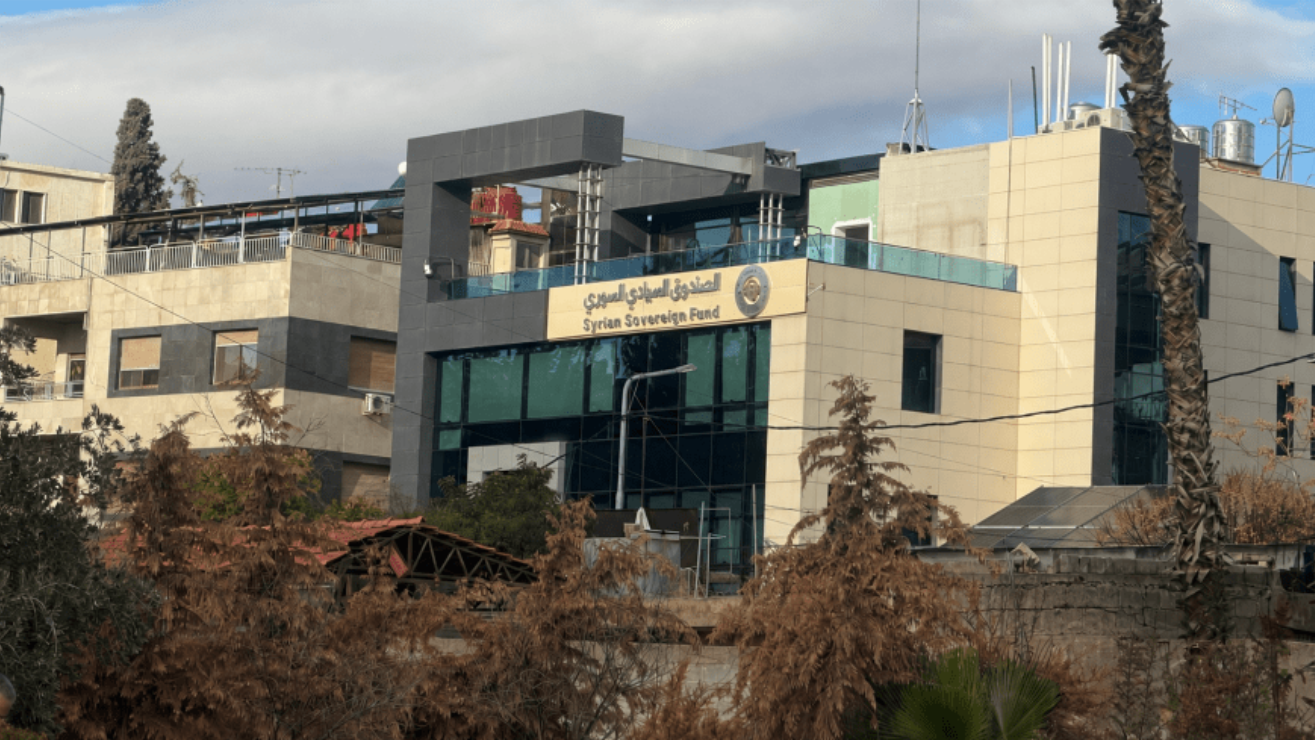
The Syrian Sovereign Fund building in the Mazzeh neighborhood of Damascus – December 28, 2025 (Enab Baladi)

The Syrian Sovereign Fund has become increasingly prominent in public debate following the launch of its website and the disclosure of some information about its structure, the sectors in which it operates, and the assets under its management. Yet a clearer public image of the Fund does not necessarily mean that its practices have improved. The information released has removed some of the institutional ambiguity, but it has not answered the most important questions: Who makes the decisions? How were assets transferred to the Fund? What will happen to confiscated and recovered assets? And who oversees the Fund when it manages extensive public property and financial resources?.

These questions affect the life of every Syrian. The management of public assets and their returns directly influences economic and social rights, as well as citizens’ right to scrutinise resources that are supposed to be managed for their benefit. It is therefore not enough for the Fund’s website to publish its objectives and a limited number of figures while withholding the information necessary for accountability. The Fund’s legal basis, governance mechanisms, and exposure to public oversight must also be examined.

The Fund’s Legal Structure and Its Implications

The Syrian Sovereign Fund was established under Decree No. 113 of 2025 as an economic institution with legal personality and financial and administrative independence. It is headquartered in Damascus and reports directly to the Presidency of the Republic. The decree gave the Fund broad objectives, including implementing development and production projects, investing resources, stimulating the economy, and turning inactive government assets into instruments of production and development.

The decree also provides for the Fund to be managed by a board of directors and a director-general. It requires quarterly and annual reports to be submitted to the Presidency and provides for financial audits by bodies described as independent from the Fund.

This structure may allow the Fund to manage distressed assets and take investment decisions more quickly than traditional public institutions. The problem, however, is that its financial and administrative independence is not matched, based on the available information, by an equivalent system of independent oversight and public accountability. The Fund reports directly to the Presidency, its leadership is appointed within the executive branch, and its reports are submitted to the same authority without being published or subjected to clear legislative or public scrutiny.

The official website does not disclose the names of all board members, their qualifications, or the process through which they were selected, despite describing the board as independent and composed of experts. Nor are there published rules requiring the disclosure of financial interests, preventing conflicts of interest, or obliging a board member to recuse themselves when considering a contract or project in which they have a direct or indirect interest.

As the new People’s Assembly begins its work, the Fund’s legal framework should be amended to make it accountable to the Assembly and require it to submit an annual report and audited financial statements, rather than limiting its accountability to the Presidency.

For an institution managing public assets on this scale, it is not enough simply to declare that the board is independent. Its composition, powers, decisions, and members’ interests must be open to verification and accountability.

What Do International Standards Require?

The Santiago Principles are a voluntary international framework consisting of 24 principles and generally accepted practices for the governance of sovereign wealth funds. They are not a legally binding international agreement, but they provide an important benchmark for assessing how such funds are managed, particularly in relation to transparency, accountability, operational independence, risk management, and investment based on clear economic and financial considerations.

The principles require a clear legal basis for the fund and an effective separation between the owner of the assets, the governing body, and the executive management. They also call for clearly defined responsibilities, transparent rules on appointments, accountability and conflicts of interest, annual reports and financial statements subject to independent audit, and disclosure of financial information, investment policies, and risk-management frameworks.

These requirements become even more important when a fund’s resources are not limited to financial surpluses or revenues from natural resources, but also include companies, real estate, land, and recovered or confiscated assets. In such cases, the legal framework should identify the origin of each asset, the legal basis for its transfer to the Fund, the method used to value it, any rights or disputes attached to it, and the rules governing whether it may be retained, sold, or offered for investment.

How Does the Syrian Fund Measure Against These Standards?

The Fund has taken a limited step towards presenting itself as an institution. This should not necessarily be regarded as a positive development in itself, but rather as a response to the minimum level of disclosure required from a public institution managing assets of this scale. It has launched a website, published its objectives and some organisational information, and stated that its governance structure is inspired by the Santiago Principles.

The website states that the Fund includes 36 specialised sectors and 11 central companies and provides more than 40,000 jobs. It also says that the Fund submits periodic reports to the Presidency and is subject to financial audits conducted by bodies independent from it. However, launching a website and publishing these figures does not amount to a meaningful shift towards transparency while the core information needed for accountability remains unavailable.

The Fund’s management has stated that it is reassessing recovered assets financially, technically, and administratively, and is building an electronic database for them. It has also said that it aims to improve their efficiency before carrying out what it described as an orderly exit that would generate returns for the state treasury. The Fund has also created a complaints office and communication channels for investors and the public.

These measures, however, form part of the basic responsibilities expected of any public institution managing assets of this magnitude. They should not be treated as sufficient evidence of sound governance. They also remain statements about internal plans and procedures unless they are translated into data and reports that can be independently verified by the public.

The website does not publish an opening balance sheet or audited financial statements. It does not identify the auditing bodies or disclose their findings. Nor does it provide a comprehensive list of the land, properties, and companies managed by the Fund, or sufficient information on their value, revenues, liabilities, or financial returns. It is also unclear whether these returns are transferred to the state treasury, reinvested, or used to finance specific projects.

Information disclosed during the Syrian-Emirati Investment Forum reveals that the scale of the Fund is considerably larger than its website suggests. According to The Syria Report, Fund officials stated that it owns or manages approximately 2,000 properties valued at around USD 2.5 billion, as well as more than 70 million square metres of land allocated for real-estate development, with planned projects valued at approximately USD 100 billion.

These projects include “New Damascus”, covering 33 million square metres and requiring an estimated USD 40–50 billion in investment, and a coastal project in Lattakia covering 11.5 million square metres, with investments potentially reaching USD 30 billion.
The report also disclosed the names of several officials and identified sectors and companies affiliated with the Fund. At the same time, it noted that the Fund’s governance mechanisms and the ultimate ownership arrangements of its assets remain only partially disclosed.

According to statements by the Fund’s management, some of the assets it manages were transferred to it through decisions issued by the Committee for Combating Illicit Enrichment. Yet there is no public register distinguishing between original state assets, assets recovered through settlements, assets confiscated by court judgments, and assets that may still be subject to ownership claims or legal disputes.

Without such distinctions, it is difficult to verify the validity of title or determine whether an asset may lawfully be sold or included in an investment partnership. It is also difficult to establish whether the rights of owners, creditors, workers, or other stakeholders were considered before the assets were transferred or disposed of.

The Impact of Ambiguity on the Economy and the Transition

The absence of disclosure is not merely a technical problem. Serious investors need to know who owns an asset, how it was valued, which authority approved its disposal, and how potential disputes will be resolved. The longer this information remains unavailable, the greater the legal and political risks, making investment more expensive and less stable.

For citizens, the issue concerns their right to know how state property is being managed and what happens to recovered funds. These assets do not belong to the Fund’s management or to the authorities currently in power. They are public resources that must be managed in accordance with the law and used to produce a measurable public benefit.

The lack of disclosure creates risks of favouritism, preferential treatment for particular investors, the sale of assets below their value, or the direction of resources towards projects that do not reflect Syrians’ social and economic priorities. The existence of these risks does not mean that misuse has already occurred. It does mean, however, that the safeguards currently in place are insufficient to prevent or independently detect it.

The risk is heightened because the Fund’s role extends far beyond the management of a limited investment portfolio. It operates in real estate, construction, telecommunications, energy, transport, industry, agriculture, tourism, natural resources, and other sectors. It can therefore influence which sectors receive financing, which assets are offered for sale or partnership, and which investors gain access to the market.

This gives the Fund an effective role in reshaping ownership and directing the Syrian economy. It may also lead to the creation of an economic centre operating alongside ministries, public institutions, and the state budget, concentrating assets, investments, and strategic decisions within a single structure.

This is particularly concerning during the transitional period. Concentrating such a role in an institution directly linked to the Presidency, before representative and oversight institutions are fully established, may entrench a new economic structure before it has been subjected to public debate or democratic scrutiny. Decisions taken today concerning land, companies, and infrastructure may become extremely difficult to revisit in the future, even if they are later found not to have served the public interest.

Reform should therefore not be limited to improving the website or publishing general figures. The Fund should disclose its opening balance sheet, financial statements, and audit reports, publish the full composition of its board; adopt binding conflict-of-interest rules, and create a public asset register identifying the origin, legal status, and value of each asset.

A clear distinction should also be made between original state assets, recovered assets, confiscated assets, and assets subject to dispute. Major decisions, particularly the sale or transfer of public assets, should be subject to independent external oversight and clear legal and judicial review.

The Sovereign Fund could play an important role in bringing assets back into productive use, attracting investment, and supporting economic recovery. Yet the scale of its powers and the breadth of the sectors it manages mean that its governance is part of the success of the political transition, not merely an internal administrative matter. Syria’s economic reconstruction cannot be built by replacing one form of opacity with another, or by concentrating wealth and economic decision-making in an institution that remains subject to limited public accountability.

Written by: Alaa Younes, Researcher, Business and Human Rights Unit, Syrian Legal Development Programme.

The Syrian Sovereign Fund: Who Is Managing the Economy of the Transition?

Aug 1, 2026    | |   This post is also available in: Arabic
The Syrian Sovereign Fund building in the Mazzeh neighborhood of Damascus – December 28, 2025 (Enab Baladi)

The Syrian Sovereign Fund has become increasingly prominent in public debate following the launch of its website and the disclosure of some information about its structure, the sectors in which it operates, and the assets under its management. Yet a clearer public image of the Fund does not necessarily mean that its practices have improved. The information released has removed some of the institutional ambiguity, but it has not answered the most important questions: Who makes the decisions? How were assets transferred to the Fund? What will happen to confiscated and recovered assets? And who oversees the Fund when it manages extensive public property and financial resources?.

These questions affect the life of every Syrian. The management of public assets and their returns directly influences economic and social rights, as well as citizens’ right to scrutinise resources that are supposed to be managed for their benefit. It is therefore not enough for the Fund’s website to publish its objectives and a limited number of figures while withholding the information necessary for accountability. The Fund’s legal basis, governance mechanisms, and exposure to public oversight must also be examined.

The Fund’s Legal Structure and Its Implications

The Syrian Sovereign Fund was established under Decree No. 113 of 2025 as an economic institution with legal personality and financial and administrative independence. It is headquartered in Damascus and reports directly to the Presidency of the Republic. The decree gave the Fund broad objectives, including implementing development and production projects, investing resources, stimulating the economy, and turning inactive government assets into instruments of production and development.

The decree also provides for the Fund to be managed by a board of directors and a director-general. It requires quarterly and annual reports to be submitted to the Presidency and provides for financial audits by bodies described as independent from the Fund.

This structure may allow the Fund to manage distressed assets and take investment decisions more quickly than traditional public institutions. The problem, however, is that its financial and administrative independence is not matched, based on the available information, by an equivalent system of independent oversight and public accountability. The Fund reports directly to the Presidency, its leadership is appointed within the executive branch, and its reports are submitted to the same authority without being published or subjected to clear legislative or public scrutiny.

The official website does not disclose the names of all board members, their qualifications, or the process through which they were selected, despite describing the board as independent and composed of experts. Nor are there published rules requiring the disclosure of financial interests, preventing conflicts of interest, or obliging a board member to recuse themselves when considering a contract or project in which they have a direct or indirect interest.

As the new People’s Assembly begins its work, the Fund’s legal framework should be amended to make it accountable to the Assembly and require it to submit an annual report and audited financial statements, rather than limiting its accountability to the Presidency.

For an institution managing public assets on this scale, it is not enough simply to declare that the board is independent. Its composition, powers, decisions, and members’ interests must be open to verification and accountability.

What Do International Standards Require?

The Santiago Principles are a voluntary international framework consisting of 24 principles and generally accepted practices for the governance of sovereign wealth funds. They are not a legally binding international agreement, but they provide an important benchmark for assessing how such funds are managed, particularly in relation to transparency, accountability, operational independence, risk management, and investment based on clear economic and financial considerations.

The principles require a clear legal basis for the fund and an effective separation between the owner of the assets, the governing body, and the executive management. They also call for clearly defined responsibilities, transparent rules on appointments, accountability and conflicts of interest, annual reports and financial statements subject to independent audit, and disclosure of financial information, investment policies, and risk-management frameworks.

These requirements become even more important when a fund’s resources are not limited to financial surpluses or revenues from natural resources, but also include companies, real estate, land, and recovered or confiscated assets. In such cases, the legal framework should identify the origin of each asset, the legal basis for its transfer to the Fund, the method used to value it, any rights or disputes attached to it, and the rules governing whether it may be retained, sold, or offered for investment.

How Does the Syrian Fund Measure Against These Standards?

The Fund has taken a limited step towards presenting itself as an institution. This should not necessarily be regarded as a positive development in itself, but rather as a response to the minimum level of disclosure required from a public institution managing assets of this scale. It has launched a website, published its objectives and some organisational information, and stated that its governance structure is inspired by the Santiago Principles.

The website states that the Fund includes 36 specialised sectors and 11 central companies and provides more than 40,000 jobs. It also says that the Fund submits periodic reports to the Presidency and is subject to financial audits conducted by bodies independent from it. However, launching a website and publishing these figures does not amount to a meaningful shift towards transparency while the core information needed for accountability remains unavailable.

The Fund’s management has stated that it is reassessing recovered assets financially, technically, and administratively, and is building an electronic database for them. It has also said that it aims to improve their efficiency before carrying out what it described as an orderly exit that would generate returns for the state treasury. The Fund has also created a complaints office and communication channels for investors and the public.

These measures, however, form part of the basic responsibilities expected of any public institution managing assets of this magnitude. They should not be treated as sufficient evidence of sound governance. They also remain statements about internal plans and procedures unless they are translated into data and reports that can be independently verified by the public.

The website does not publish an opening balance sheet or audited financial statements. It does not identify the auditing bodies or disclose their findings. Nor does it provide a comprehensive list of the land, properties, and companies managed by the Fund, or sufficient information on their value, revenues, liabilities, or financial returns. It is also unclear whether these returns are transferred to the state treasury, reinvested, or used to finance specific projects.

Information disclosed during the Syrian-Emirati Investment Forum reveals that the scale of the Fund is considerably larger than its website suggests. According to The Syria Report, Fund officials stated that it owns or manages approximately 2,000 properties valued at around USD 2.5 billion, as well as more than 70 million square metres of land allocated for real-estate development, with planned projects valued at approximately USD 100 billion.

These projects include “New Damascus”, covering 33 million square metres and requiring an estimated USD 40–50 billion in investment, and a coastal project in Lattakia covering 11.5 million square metres, with investments potentially reaching USD 30 billion.
The report also disclosed the names of several officials and identified sectors and companies affiliated with the Fund. At the same time, it noted that the Fund’s governance mechanisms and the ultimate ownership arrangements of its assets remain only partially disclosed.

According to statements by the Fund’s management, some of the assets it manages were transferred to it through decisions issued by the Committee for Combating Illicit Enrichment. Yet there is no public register distinguishing between original state assets, assets recovered through settlements, assets confiscated by court judgments, and assets that may still be subject to ownership claims or legal disputes.

Without such distinctions, it is difficult to verify the validity of title or determine whether an asset may lawfully be sold or included in an investment partnership. It is also difficult to establish whether the rights of owners, creditors, workers, or other stakeholders were considered before the assets were transferred or disposed of.

The Impact of Ambiguity on the Economy and the Transition

The absence of disclosure is not merely a technical problem. Serious investors need to know who owns an asset, how it was valued, which authority approved its disposal, and how potential disputes will be resolved. The longer this information remains unavailable, the greater the legal and political risks, making investment more expensive and less stable.

For citizens, the issue concerns their right to know how state property is being managed and what happens to recovered funds. These assets do not belong to the Fund’s management or to the authorities currently in power. They are public resources that must be managed in accordance with the law and used to produce a measurable public benefit.

The lack of disclosure creates risks of favouritism, preferential treatment for particular investors, the sale of assets below their value, or the direction of resources towards projects that do not reflect Syrians’ social and economic priorities. The existence of these risks does not mean that misuse has already occurred. It does mean, however, that the safeguards currently in place are insufficient to prevent or independently detect it.

The risk is heightened because the Fund’s role extends far beyond the management of a limited investment portfolio. It operates in real estate, construction, telecommunications, energy, transport, industry, agriculture, tourism, natural resources, and other sectors. It can therefore influence which sectors receive financing, which assets are offered for sale or partnership, and which investors gain access to the market.

This gives the Fund an effective role in reshaping ownership and directing the Syrian economy. It may also lead to the creation of an economic centre operating alongside ministries, public institutions, and the state budget, concentrating assets, investments, and strategic decisions within a single structure.

This is particularly concerning during the transitional period. Concentrating such a role in an institution directly linked to the Presidency, before representative and oversight institutions are fully established, may entrench a new economic structure before it has been subjected to public debate or democratic scrutiny. Decisions taken today concerning land, companies, and infrastructure may become extremely difficult to revisit in the future, even if they are later found not to have served the public interest.

Reform should therefore not be limited to improving the website or publishing general figures. The Fund should disclose its opening balance sheet, financial statements, and audit reports, publish the full composition of its board; adopt binding conflict-of-interest rules, and create a public asset register identifying the origin, legal status, and value of each asset.

A clear distinction should also be made between original state assets, recovered assets, confiscated assets, and assets subject to dispute. Major decisions, particularly the sale or transfer of public assets, should be subject to independent external oversight and clear legal and judicial review.

The Sovereign Fund could play an important role in bringing assets back into productive use, attracting investment, and supporting economic recovery. Yet the scale of its powers and the breadth of the sectors it manages mean that its governance is part of the success of the political transition, not merely an internal administrative matter. Syria’s economic reconstruction cannot be built by replacing one form of opacity with another, or by concentrating wealth and economic decision-making in an institution that remains subject to limited public accountability.

Written by: Alaa Younes, Researcher, Business and Human Rights Unit, Syrian Legal Development Programme.

Advisory Services Enquiry


Please enable JavaScript in your browser to complete this form.
Preferred Mode of Consultation:

This will close in 0 seconds

استفسار عن خدمات الاستشارات


Please enable JavaScript in your browser to complete this form.
طريقة التواصل المفضلة

This will close in 0 seconds