
Des 8, 2025  |   This post is also available in: Arabic

On the first anniversary of the fall of the Assad regime, we mark a defining moment in Syria’s modern history.

This day stands as a reminder of the profound suffering Syrians endured, and of the collective determination to rebuild a country grounded in justice, dignity, and the rule of law.

Over the past year, the Syrian Legal Development Programme (SLDP) has contributed to shaping the early foundations of this transition through principled work and close coordination with Syrian civil society, victims’ and survivors’ associations, national institutions, UN mechanisms, and states.

Throughout 2025, SLDP’s work contributed to several core advances in Syria’s justice and human rights landscape:
* Elevating the rights of communities most affected by violations: SLDP supported survivors of chemical attacks, families of the disappeared, displaced communities, and residents affected by housing, land, and property (HLP) rights violations, ensuring their perspectives guide transitional justice and accountability efforts

* Designing victim-centered initiatives involving affected community groups on HLP rights violations, and conducting high-level engagements in Syria. This model aimed to support transitional justice efforts and offer a blueprint for addressing HLP violations nationwide. SLDP also began mapping businesses involved in HLP rights violations for future engagement and accountability work and engagement with the UN Special Rapporteur on the right to adequate housing.

* Strengthening victims’ participation and influence: SLDP supported associations of victims of human rights violations committed by all parties to engage with the National Commission on Missing Persons and the National Commission on Transitional Justice, advancing victims’ participation as a central principle guiding emerging transitional mechanisms.

* Enhancing state–civil society engagement: Through structured briefings at the Human Rights Council, and bilateral meetings, SLDP contributed to improving states’ understanding of the human rights situation in Syria following the fall of the Assad regime and to align their positions with Syrians’ human rights, democratic transformation, and justice priorities.

* Advancing transnational judicial solidarity for the pursuit of justice against the Syrian regime: SLDP and victims and families groups will soon share updates on a new universal jurisdiction case in Argentina. More details to be shared.

* Ensuring the strategic role of UN Human Rights Bodies: Through sustained engagement with UN Human Rights Bodies, including Special Procedures and Treaty-Based Bodies, SLDP supported efforts to ensure UN Bodies will play a strategic role in Syria’s new phase to advance, amplify and support Syrian-led calls for reform, accountability, and human rights protection after the fall of Assad.

* Supporting national transitional justice architecture: By co-developing, convening, and facilitating the Transitional Justice Coordination Group — comprising around 50 Syrian organisations — SLDP helped develop shared principles on truth, remedy, and guarantees of non-recurrence now informing national institutions.

* Building the legal foundations of the transition: SLDP produced analyses on constitutional obligations, criminal justice pathways and reform, and electoral frameworks which are now used by national commissions, policymakers, and international partners in their work during Syria’s transitional phase.

* Embedding human rights safeguards in reconstruction and the economy: Through its Human Rights and Business Unit, SLDP advanced human rights due diligence standards vis-a-vis ministries, UN agencies, businesses, and donors, and convened Syria’s first conference on Business and Human Rights
— setting golden standards for rights-based economic recovery.

* Advancing sanctions-related advocacy by issuing a position paper endorsing the lifting of sectoral sanctions while maintaining individual sanctions against human rights abusers—an approach later adopted by multiple civil society groups. SLDP has been holding regular meetings with U7 and EU foreign ministries, sanctions desks, and multilateral partners to promote sanctions relief aligned with human rights protections and economic stabilization in the post-Assad context.

* Raising awareness of business’ human rights responsibilities across key areas—including reconstruction and HLP rights, responsible investment, and environmental protection—through targeted outreach sessions, publications, and social media engagement. SLDP has also advocated for business respect for human rights in Syria at major international forums, including the UNDP Global Programme Annual Meeting, the ICAR Annual Meeting, the Africa–Arab States Regional Dialogue on BHR, and events on Syrian asset recovery and the establishment of a Syrian Victims Fund.

* Advocating strongly for the integration of Human Rights Due Diligence (HRDD) in all our meetings with government officials and humanitarian actors, emphasizing that reconstruction and development efforts must be firmly grounded in a human rights centred approach. By promoting HRDD, we aimed to ensure that emerging policies and programmes uphold the rights, dignity, and protection of affected communities throughout every stage of recovery and development.

One year on, the transition remains fragile, and the foundations for a rights-based future must be strengthened.

SLDP remains committed to working with all partners — Syrian and international — to support truth, justice, institutional reform, and non-recurrence, and to contribute constructively to a Syria where dignity is protected and accountability is the norm.

Our commitment continues — for a just, transparent, and rights-centred future for all.

“ We may have a hundred reasons to be afraid, but we have a million reasons to be hopeful. Over the past year, Syria’s civil society has moved from watching the world rush to normalixe a criminal regime to standing firmly beside our people in Syria—engaging national bodies on justice, pressing for accountability for all victims of violations before and a er 8 December 2024, and driving the conversation forward. This is a moment of defiance and determination, held together by a growing hope.”

— Sana Kikkia, Executive Director, Syrian Legal Development Programme

The First Anniversary of the Fall of the Assad Regime

Des 8, 2025  |   This post is also available in: Arabic
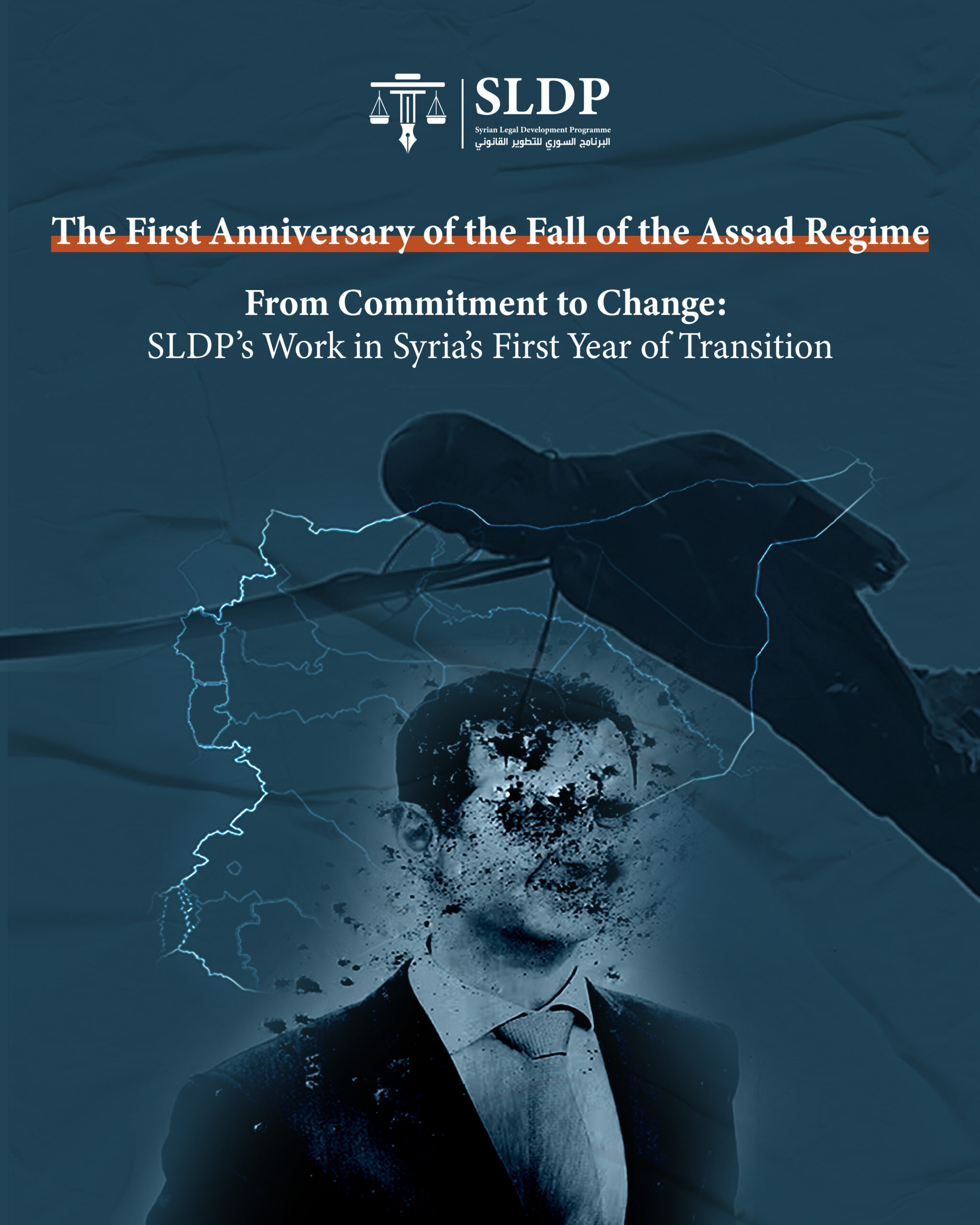
On the first anniversary of the fall of the Assad regime, we mark a defining moment in Syria’s modern history.

This day stands as a reminder of the profound suffering Syrians endured, and of the collective determination to rebuild a country grounded in justice, dignity, and the rule of law.

Over the past year, the Syrian Legal Development Programme (SLDP) has contributed to shaping the early foundations of this transition through principled work and close coordination with Syrian civil society, victims’ and survivors’ associations, national institutions, UN mechanisms, and states.

Throughout 2025, SLDP’s work contributed to several core advances in Syria’s justice and human rights landscape:
* Elevating the rights of communities most affected by violations: SLDP supported survivors of chemical attacks, families of the disappeared, displaced communities, and residents affected by housing, land, and property (HLP) rights violations, ensuring their perspectives guide transitional justice and accountability efforts

* Designing victim-centered initiatives involving affected community groups on HLP rights violations, and conducting high-level engagements in Syria. This model aimed to support transitional justice efforts and offer a blueprint for addressing HLP violations nationwide. SLDP also began mapping businesses involved in HLP rights violations for future engagement and accountability work and engagement with the UN Special Rapporteur on the right to adequate housing.

* Strengthening victims’ participation and influence: SLDP supported associations of victims of human rights violations committed by all parties to engage with the National Commission on Missing Persons and the National Commission on Transitional Justice, advancing victims’ participation as a central principle guiding emerging transitional mechanisms.

* Enhancing state–civil society engagement: Through structured briefings at the Human Rights Council, and bilateral meetings, SLDP contributed to improving states’ understanding of the human rights situation in Syria following the fall of the Assad regime and to align their positions with Syrians’ human rights, democratic transformation, and justice priorities.

* Advancing transnational judicial solidarity for the pursuit of justice against the Syrian regime: SLDP and victims and families groups will soon share updates on a new universal jurisdiction case in Argentina. More details to be shared.

* Ensuring the strategic role of UN Human Rights Bodies: Through sustained engagement with UN Human Rights Bodies, including Special Procedures and Treaty-Based Bodies, SLDP supported efforts to ensure UN Bodies will play a strategic role in Syria’s new phase to advance, amplify and support Syrian-led calls for reform, accountability, and human rights protection after the fall of Assad.

* Supporting national transitional justice architecture: By co-developing, convening, and facilitating the Transitional Justice Coordination Group — comprising around 50 Syrian organisations — SLDP helped develop shared principles on truth, remedy, and guarantees of non-recurrence now informing national institutions.

* Building the legal foundations of the transition: SLDP produced analyses on constitutional obligations, criminal justice pathways and reform, and electoral frameworks which are now used by national commissions, policymakers, and international partners in their work during Syria’s transitional phase.

* Embedding human rights safeguards in reconstruction and the economy: Through its Human Rights and Business Unit, SLDP advanced human rights due diligence standards vis-a-vis ministries, UN agencies, businesses, and donors, and convened Syria’s first conference on Business and Human Rights
— setting golden standards for rights-based economic recovery.

* Advancing sanctions-related advocacy by issuing a position paper endorsing the lifting of sectoral sanctions while maintaining individual sanctions against human rights abusers—an approach later adopted by multiple civil society groups. SLDP has been holding regular meetings with U7 and EU foreign ministries, sanctions desks, and multilateral partners to promote sanctions relief aligned with human rights protections and economic stabilization in the post-Assad context.

* Raising awareness of business’ human rights responsibilities across key areas—including reconstruction and HLP rights, responsible investment, and environmental protection—through targeted outreach sessions, publications, and social media engagement. SLDP has also advocated for business respect for human rights in Syria at major international forums, including the UNDP Global Programme Annual Meeting, the ICAR Annual Meeting, the Africa–Arab States Regional Dialogue on BHR, and events on Syrian asset recovery and the establishment of a Syrian Victims Fund.

* Advocating strongly for the integration of Human Rights Due Diligence (HRDD) in all our meetings with government officials and humanitarian actors, emphasizing that reconstruction and development efforts must be firmly grounded in a human rights centred approach. By promoting HRDD, we aimed to ensure that emerging policies and programmes uphold the rights, dignity, and protection of affected communities throughout every stage of recovery and development.

One year on, the transition remains fragile, and the foundations for a rights-based future must be strengthened.

SLDP remains committed to working with all partners — Syrian and international — to support truth, justice, institutional reform, and non-recurrence, and to contribute constructively to a Syria where dignity is protected and accountability is the norm.

Our commitment continues — for a just, transparent, and rights-centred future for all.

“ We may have a hundred reasons to be afraid, but we have a million reasons to be hopeful. Over the past year, Syria’s civil society has moved from watching the world rush to normalixe a criminal regime to standing firmly beside our people in Syria—engaging national bodies on justice, pressing for accountability for all victims of violations before and a er 8 December 2024, and driving the conversation forward. This is a moment of defiance and determination, held together by a growing hope.”

— Sana Kikkia, Executive Director, Syrian Legal Development Programme

Advisory Services Enquiry


Please enable JavaScript in your browser to complete this form.
Preferred Mode of Consultation:

This will close in 0 seconds

استفسار عن خدمات الاستشارات


Please enable JavaScript in your browser to complete this form.
طريقة التواصل المفضلة

This will close in 0 seconds