

July 27, 2026 | | This post is also available in: Arabic
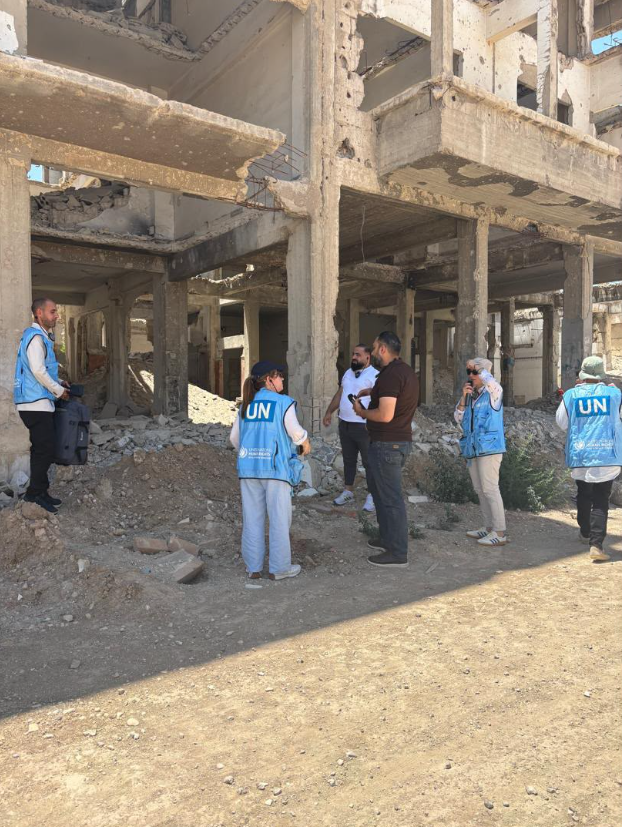
The visit of the United Nations Special Rapporteur on the Human Rights of Internally Displaced Persons (IDPs) to Syria took place from 10 to 21 July 2026, at a defining moment in the country’s transition.
While the fall of the Assad regime in December 2024 created renewed hopes for return and reconstruction, internal displacement remains far from resolved. Many families continue to face uncertainty on many different levels: insecurity, destroyed homes, unresolved housing, land and property (HLP) claims, missing civil documentation, and the absence of effective legal remedies preventing them from returning safely and voluntarily.
At the same time, renewed violence in the Syrian Coast, Sweida and other parts of the country since early 2025 has demonstrated that internal displacement is no longer solely a legacy of the former regime but continues to arise during the transitional period itself. Addressing displacement must therefore become an integral component of Syria’s broader efforts towards transitional justice.
Discussions with affected communities across the country highlighted a wide range of situations, from Assad-era redevelopment projects in Damascus, where many residents continue to challenge restitution and compensation models they consider inadequate to the severity of the violations suffered by Assad, to the continued inability of many displaced Kurdish families to recover their homes in Afrin, Tell Abyad and Ras al-Ayn and many families being unable to return to their homes in the Coast or in Sweida, where the absence of a national strategy is aggravating the lives of thousands of displaced.
Based on the above, displacement in Syria can no longer be approached solely as a humanitarian issue requiring emergency assistance. Rather, it reflects a complex intersection of housing, land and property rights, accountability, access to justice, civic participation, social cohesion and legal reform, requiring a comprehensive, rights-based response.
Syria should seize the momentum created by the Special Rapporteur’s visit to develop a comprehensive national legislative and policy framework on internal displacement. Such a framework should move beyond policies centred exclusively on return and adopt a rights-based approach that would both take into account preventing displacement and providing systemic responses when displacement occurs.
The Challenge of Legislative Gaps: Responding before and after displacement
Internal displacement in Syria is often understood as one of the principal legacies of the armed conflict and the policies of the former Assad regime. Yet, after the fall of the regime, major developments during 2025 and 2026 and the ongoing impact of displacement demonstrated that displacement cannot be regarded solely as a historical consequence of the former regime.
As a result, displaced persons continue to navigate inadequate legal procedures that fail to address the interconnected nature of displacement and its consequences.
Without a comprehensive national framework, reconstruction efforts and return policies risk being ineffective, potentially consolidating or reproducing patterns of exclusion and dispossession rather than providing adequate responses to the needs of displaced people.
As a quick reminder, the obligations and regulations for IDPs have been consolidated into a coherent international framework through three complementary instruments: the UN Guiding Principles on Internal Displacement, the IASC Framework on Durable Solutions for Internally Displaced Persons, and the Pinheiro Principles on Housing and Property Restitution for Refugees and Displaced Persons.
Together, these instruments provide the principal international standards for preventing arbitrary displacement, protecting internally displaced persons throughout displacement, and enabling durable solutions grounded in human rights.
Prevention and non-recurrence as an innovative approach to IDPs standards
The cornerstone of an innovative approach to internal displacement would require that a national policy framework on IDPs be based on human rights standards, particularly the UN Guiding Principles on Internal Displacement. Principles 5 to 9 establish the State’s obligation to prevent arbitrary displacement, yet they provide limited directly applicable guidance on the national institutional mechanisms through which this obligation should be implemented.
A true ambition of such an approach lies in building a framework that systematically and structurally prevents the occurrence of new displacements.
Most national IDP laws from other countries focus on protection and assistance after displacement has occurred, whereas very few establish mechanisms genuinely aimed at preventing displacement. Syria, therefore, has a unique opportunity to adopt an innovative approach by making prevention and guarantees of non-recurrence the organising principles of a national displacement framework.
Such a framework should require that any legislative, administrative or military decision that may result in, or significantly aggravate, internal displacement be subject to a prior assessment of its compatibility with national and international standards protecting internally displaced persons; thereby giving practical effect to the preventive obligations contained in Principles 5 to 9 of the UN Guiding Principles. The national framework could include within the scope of its systematic assessment, for example, reconstruction laws and urban redevelopment plans, military operations, security measures, or large-scale infrastructure projects that risk causing displacement or preventing return.
The allegations surrounding redevelopment proposals in Jobar and Qaboun illustrate why such safeguards are needed. For many residents, the proposed compensation models risk creating a new cycle of dispossession by effectively requiring displaced residents to finance reconstruction through the loss of part of their own property rights. A displacement impact assessment could have required an independent review of these proposals before their adoption, assessing whether they complied with international standards, whether affected communities had been meaningfully consulted, and whether alternative approaches could better facilitate voluntary return rather than renewed displacement.
This preventive “displacement impact assessment” should not be carried out solely by the institution responsible for proposing or implementing the initial measure that may cause such displacement. Rather, it should involve a review by another competent authority, such as an independent commission, Parliament, the judiciary, a national human rights institution, or another oversight body. Depending on the institutional model adopted, that body could be empowered to issue binding decisions, require modifications, suspend implementation pending further review, or provide non-binding advisory opinions on the displacement risks associated with the proposed measure.
Embedding such institutional safeguards would ensure that the risk of displacement is considered before government action is taken, rather than addressed only once violations have already occurred. In this way, Syria would operationalise the preventive obligations already recognised in concrete domestic legal procedures and institutional safeguards.
In doing so, Syria could move beyond the traditional humanitarian approach to internal displacement and establish one of the first national frameworks centred on the structural prevention of displacement.
Addressing HLP violations After Displacement
Once displacement has occurred, the absence of effective national planning and comprehensive legal frameworks not only prolongs displacement but also exacerbates existing vulnerabilities, giving rise to further violations of the rights of those internally displaced.
In the particular context of the transition, one of the principal factors aggravating the situation for internally displaced persons is HLP rights. International law already provides a comprehensive legal framework to address HLP once displacement has occurred, particularly in contexts of large-scale displacement where reconstruction policies, urban redevelopment and property restitution give rise to complex legal and practical obstacles.
In the absence of a coherent national policy framework, these principles should guide the actions of the Syrian authorities and inspire the development of future national legislation. By addressing internal displacement both before and after it occurs, such a framework would help prevent renewed violations while giving practical effect to guarantees of non-recurrence.
The need for such a framework is illustrated by the continuing legacy of redevelopment projects initiated under Decree No. 66, including Marota City. During the Special Rapporteur’s visit, affected communities raised concerns that the redevelopment process effectively placed restitution beyond reach, despite allegations that the compensation and share-based schemes offered in its place failed to adequately restore their HLP rights. Guided by the Pinheiro Principles, it is needed to establish clear criteria for determining when restitution remains possible and, where it is not, to ensure that any alternative remedy provides genuine and adequate reparation.
The Pinheiro Principles set out detailed standards on HLP restitution, recognising restitution as the preferred remedy and establishing procedural safeguards to ensure effective access to remedies and compensation where restitution is not possible. The Pinheiro Principles reaffirm that displaced persons have the right to voluntary, safe and dignified return and that housing, land and property restitution should be the preferred remedy whenever possible (Pinheiro Principles 2 and 10). Compensation should only be considered where restitution is factually impossible or where the affected person knowingly and voluntarily accepts compensation in lieu of restitution (Pinheiro Principle 21).
This approach is particularly relevant in Syria, where internally displaced persons continue to face obstacles in recovering their homes, land and property as a result of destruction, loss of documentation, secondary occupation, unresolved ownership disputes, discriminatory planning measures and recent allegations of forced evictions linked to redevelopment projects.
The Pinheiro Principles also establish a number of procedural safeguards that are directly applicable to the current transitional context. These include the obligation to establish accessible, independent and non-discriminatory restitution procedures (Principles 12–15); ensure equal access to restitution for women and men (Principle 4); recognise diverse forms of tenure and ownership, including situations where documentary evidence has been lost or destroyed; and guarantee effective judicial review and remedies for those whose housing, land or property rights have been violated.
Equally important, the implementation of any restitution framework should be carried out with the meaningful participation of affected communities. Civil society organisations and affected communities repeatedly emphasised the need for greater consultation in the design of reconstruction and redevelopment policies. Ensuring that internally displaced persons are able to participate meaningfully in decisions affecting their homes, land and property is essential not only to the legitimacy of restitution processes, but also to building trust and supporting durable solutions.
Combined with a preventive framework based on displacement impact assessments, the Pinheiro Principles would ensure that Syria addresses both sides of displacement: preventing future displacement while while systematically addressing with restitution or compensation the housing, land and property disputes that continue to prevent durable solutions today.
Written by: Adrian Lakrichi, Legal Analyst, the International Law Support Unit